
ARTICLES
Uncover everything BostonPro Car Service offers
Silicon Valley Corporate Travel Guide for Executives
Silicon Valley corporate travel does not work like a normal business trip. There is no single downtown, no central business district where every meeting happens to be a short cab ride away. A day in the Valley can mean a venture capital meeting in Menlo Park, a campus visit in Cupertino, and a dinner in Palo Alto, each a 20 to 40 minute drive apart depending on traffic. Executives who plan for the Valley the way they would plan for Boston or Manhattan often lose an hour or more a day to routing mistakes and unexpected traffic.
The schedules that visit the region also tend to be compressed. Investors flying in for a round of pitch meetings, board members attending a single all-day session, or a founding team on a roadshow will often stack three or four meetings into a single day across three or four different cities. In a market like this, a late arrival to a board meeting or a VC pitch carries real consequences, not just an inconvenience. This guide is built for the people who plan those trips: executive assistants, corporate travel managers, and the founders, investors, and executives who fly in themselves and want to get it right the first time.
What Makes Silicon Valley Corporate Travel Different
Silicon Valley corporate travel is defined by distance, not density. Unlike Boston or Manhattan, there is no single business district, so a single day can mean a VC meeting in Menlo Park, a campus visit in Cupertino, and a dinner in Palo Alto, each 20 to 40 minutes apart. Executives who treat it like a normal city trip often lose an hour or more a day to traffic and routing mistakes. The visitors who move efficiently are the ones who plan transportation around the meeting schedule, not the other way around.
That planning starts with two decisions before the trip even begins: which airport to fly into, and how much buffer time to build between stops. Both depend entirely on where the meetings actually are, which is why treating the Valley as one destination, rather than a loose collection of business districts spread across roughly 40 miles, is the first mistake to avoid.
Choosing the Right Airport: SFO vs. SJC vs. OAK
The Bay Area has three major commercial airports, and the right one depends on where the meetings are, not which airport has the most flights.
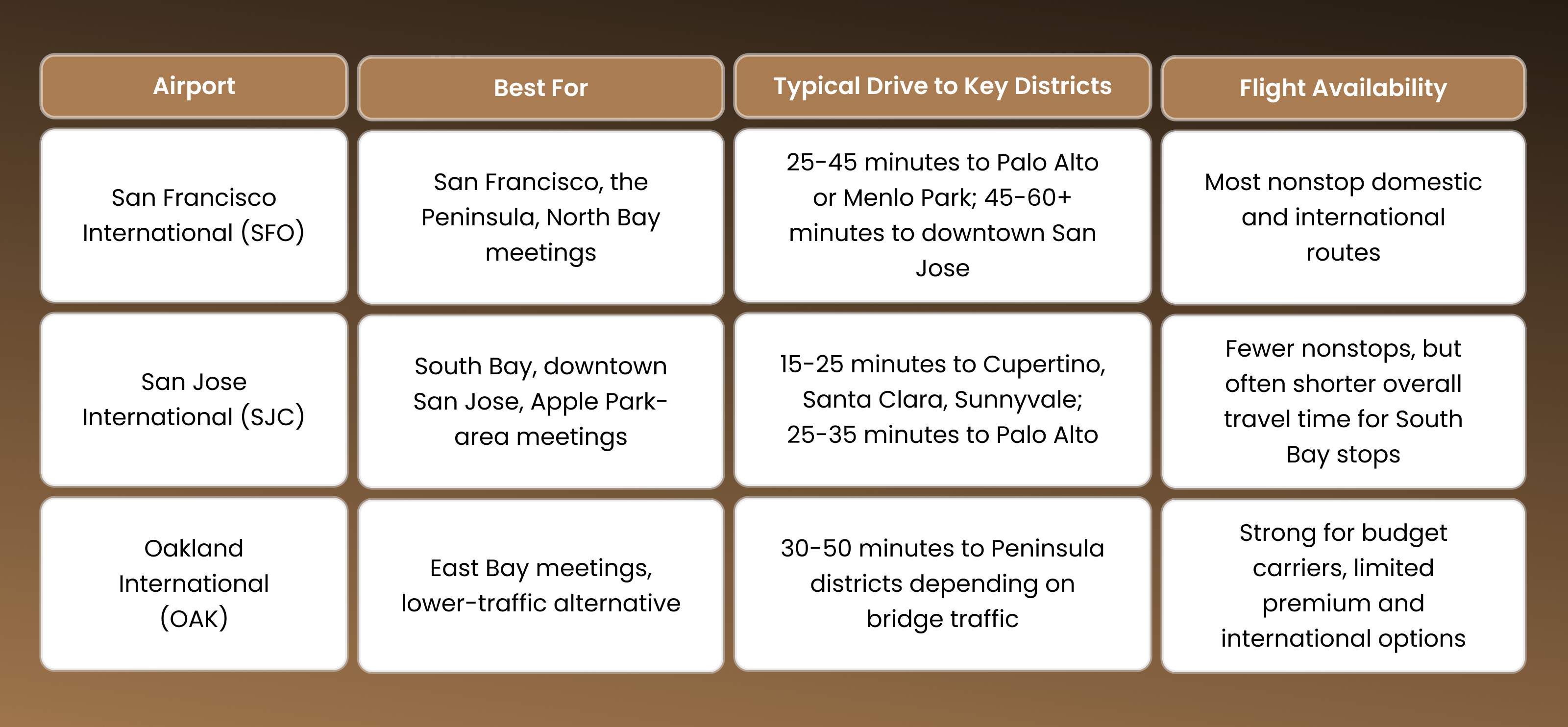
San Francisco International (SFO) makes the most sense for executives whose meetings are concentrated in San Francisco itself or on the northern Peninsula. It also has by far the widest range of nonstop flights, which matters for East Coast travelers trying to avoid a connection.
San Jose International (SJC) is often the smarter pick for anyone spending the day in the South Bay, whether that means Cupertino, Santa Clara, Sunnyvale, or a corporate campus near Apple Park. The airport sits closer to those districts, which can save 20 to 30 minutes each way compared to flying into SFO and driving south through peak traffic.
Oakland International (OAK) is worth considering for East Bay meetings or simply as a lower-traffic alternative when SFO fares spike during a busy conference week. It generally has fewer premium and international routes, so it works best when flight flexibility is not the priority.
The short version: match the airport to the first meeting of the day, not to habit. A South Bay itinerary that defaults to SFO because it is the most familiar airport name is often the itinerary that starts the trip an hour behind schedule.
How Much Ground Transportation Costs for Silicon Valley Business Travel
Executive ground transportation in Silicon Valley typically runs $120 to $180 for a one-way SFO or SJC airport transfer in a sedan or SUV, while a full day of hourly service for VC meetings or a multi-stop roadshow usually falls between $700 and $1,200 depending on vehicle class and hours booked. Multi-executive trips with a Sprinter van for a founding team or board typically start higher. Rates rise during peak commute windows and major conference weeks, so booking ahead protects both price and availability.
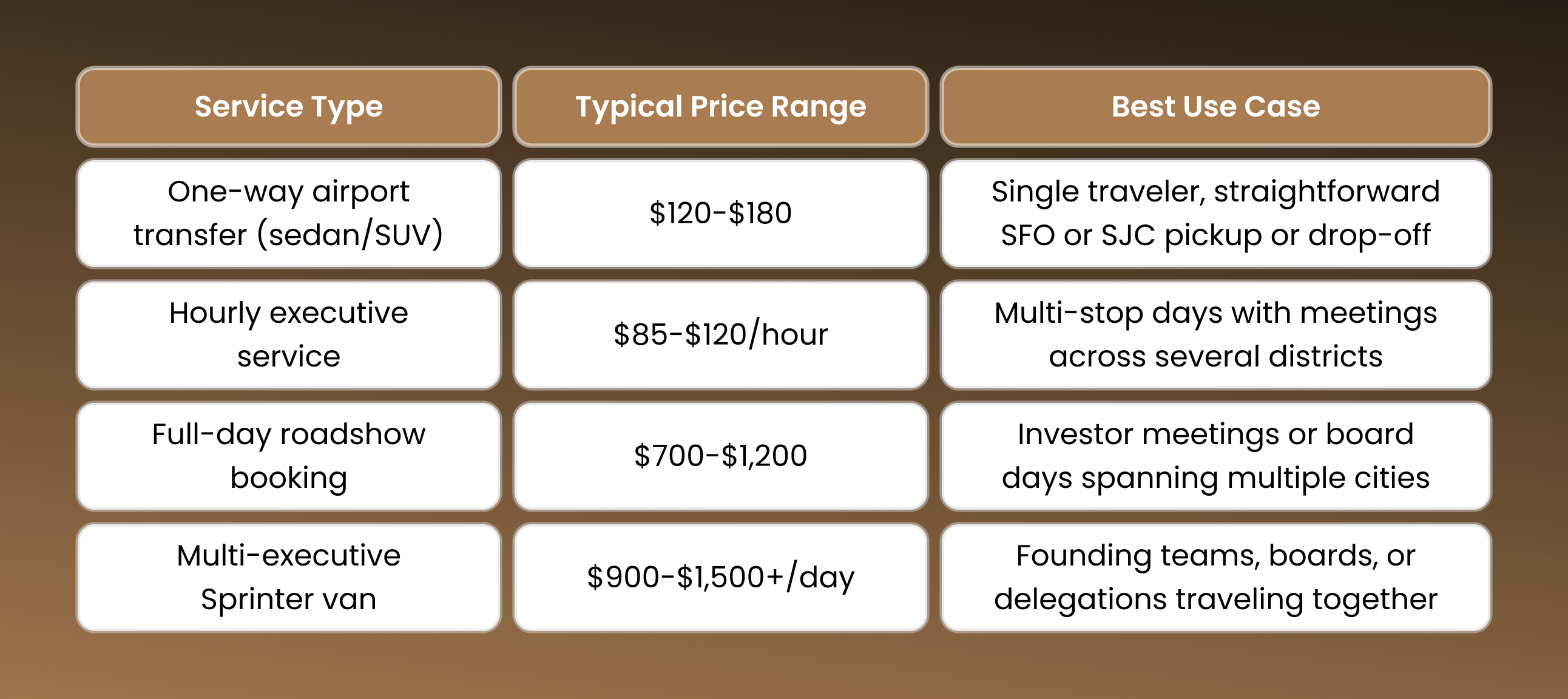
A few factors consistently move the price up or down. Peak commute windows, roughly 7 to 10 a.m. and 3:30 to 7 p.m. on weekdays, add both time and cost to any booking. Wait time between meetings, especially when a driver is asked to stay with the vehicle during a long meeting, is typically billed hourly. Vehicle class matters too, since an SUV or Sprinter van costs more than a standard sedan. Finally, advance notice makes a real difference during major conference weeks, when demand for executive vehicles across the Valley spikes and last-minute bookings can be both more expensive and harder to secure at all.
Navigating the Valley: Key Business Districts and What to Know
Understanding the geography of Silicon Valley makes the difference between a smooth day and a scramble between meetings.
Palo Alto and Sand Hill Road
Sand Hill Road is the physical center of the venture capital industry, home to many of the country's best known VC firms, along with Stanford University and Stanford Research Park nearby. Meetings here tend to run close together, and parking near the smaller VC offices is limited, so a driver who can drop at the entrance and circle back saves real time.
Menlo Park and Mountain View
Menlo Park sits just north of Palo Alto and shares much of the same venture capital density, while Mountain View is home to several major tech campuses. The two are close enough that a single morning can reasonably include stops in both, but routing through El Camino Real during commute hours can add significant time compared to using US-101.
Cupertino, Santa Clara, and Sunnyvale
This cluster is where many corporate headquarters and large tech campuses are concentrated, including the area around Apple Park. Visits here often involve campus security check-in procedures that add time before a meeting actually starts, so building in extra arrival buffer matters more here than almost anywhere else in the Valley.
San Jose and Downtown South Bay
Downtown San Jose is the region's largest concentration of convention and conference activity, anchored by the San Jose McEnery Convention Center. Traffic patterns here behave more like a traditional downtown, with predictable congestion around major events, which makes it easier to plan around than the more spread-out districts to the north.
Timing and Traffic: When Silicon Valley Business Travel Gets Difficult
US-101 and I-280 are the two main corridors connecting the Peninsula to the South Bay, and both follow predictable, if frustrating, congestion patterns. Weekday mornings from roughly 7 to 10 a.m. and afternoons from 3:30 to 7 p.m. see the heaviest slowdowns, particularly on US-101 through the Palo Alto to San Jose stretch. I-280 tends to move somewhat faster during peak hours but adds distance for certain routes, so the better corridor depends on the specific trip.
The bigger risk for visiting executives is not any single traffic jam, but the way back-to-back meetings across different cities compress a schedule that looked reasonable on paper. A day built around four meetings in four different districts leaves very little room for a fifteen-minute delay before the whole afternoon slips. Building a buffer of at least 20 to 30 minutes between meetings in different districts, and scheduling flights for mid-morning arrivals rather than the first flight of the day, gives a trip enough slack to absorb the inevitable slowdown without cascading into a missed meeting.
What to Book Before You Land: A Pre-Trip Checklist
Before a Silicon Valley business trip, confirm four things: ground transportation reserved in advance rather than booked curbside, a driver briefed on the full day's itinerary and not just the airport leg, a backup vehicle if more than one executive is traveling together, and any visitor or security requirements for corporate campuses on the schedule. Executives who lock these in before landing avoid the two most common failure points: last-minute vehicle availability during peak travel weeks and gaps between back-to-back meetings.
- Reserve ground transportation in advance. Curbside booking during a busy conference week is unreliable and often more expensive than a scheduled reservation.
- Brief the driver on the full itinerary, not just the airport pickup, so routing decisions account for the whole day rather than a single leg.
- Arrange a backup vehicle for any trip involving more than one executive traveling together, so a delay with one car does not stall the entire group.
- Book dinner and event transfers alongside meeting transportation, rather than treating them as a separate, later decision.
- Confirm campus visitor and security requirements ahead of time for any stop at a corporate headquarters, since check-in procedures can add real time before a meeting officially starts.
Frequently Asked Questions
What's the best airport for a Sand Hill Road meeting?
San Francisco International (SFO) is usually the better choice for Sand Hill Road, since it offers more nonstop flight options and the drive to Palo Alto or Menlo Park typically runs 25 to 45 minutes depending on traffic. San Jose International (SJC) can work as well if the rest of the day includes South Bay stops.
How far in advance should I book executive car service in Silicon Valley?
Booking at least one to two weeks ahead is a safe standard for a normal business trip, and three to four weeks ahead during major conference weeks when demand for executive vehicles spikes across the region.
Can one car service handle a multi-city, multi-meeting day?
Yes, and this is generally the more efficient approach compared to booking separate transfers for each leg. A single hourly booking with a driver who has the full itinerary in advance can move between Palo Alto, Mountain View, and San Jose in one day without the handoff delays that come from switching providers between stops.
Is it faster to fly into San Jose or San Francisco for a South Bay meeting?
San Jose International (SJC) is typically faster for South Bay destinations like Cupertino, Santa Clara, or Sunnyvale, often saving 20 to 30 minutes each way compared to flying into SFO and driving south through Peninsula traffic.
What should out-of-town executives know about Silicon Valley traffic patterns?
The main corridors, US-101 and I-280, see the heaviest congestion on weekday mornings from roughly 7 to 10 a.m. and afternoons from 3:30 to 7 p.m. The bigger risk is not any single delay but how quickly a full day of meetings across different cities can compress once one stop runs long, which is why buffer time between meetings matters more here than in a single-district city.
Traveling to Silicon Valley from Boston
For Boston-based companies, a Silicon Valley trip is often just half of a longer travel day that starts with a Logan Airport departure and ends with a full afternoon of meetings 3,000 miles away. That combination puts an even higher premium on getting the ground transportation right on the other end, since there is little room left in the schedule to recover from a routing mistake after a cross-country flight.
BostonPro Car Service has expanded into the Bay Area, which means East Coast companies sending executives west can now book one trusted provider for both ends of the trip rather than coordinating a Boston car service and a separate, unfamiliar Silicon Valley provider. The same standard of a briefed driver, a reserved vehicle, and a plan built around the actual meeting schedule applies whether the pickup is at Logan or at SFO.
If your team has an upcoming trip to the Bay Area, reach out to BostonPro Car Service for a quote on airport transfers, hourly service, or a full-day roadshow booking.