

ARTICLES
Uncover everything BostonPro Car Service offers
Corporate Transportation RFP Guide: What to Include

A corporate transportation RFP (request for proposal) is a formal procurement document companies use to solicit competitive bids from ground transportation providers for executive travel, airport transfers, and event logistics. A complete corporate transportation RFP should include scope of service, fleet requirements, service level agreements, pricing structure, insurance and compliance documentation, technology integration capabilities, and account management terms. Most enterprise procurement teams evaluate three to five vendors over a four to six week cycle, with contracts typically running one to three years. To request a proposal from BostonPro Car Service for Greater Boston corporate ground transportation, visit bostonprocarservice.com or call +1 857 381-3564.
What is a corporate transportation RFP?
A corporate transportation RFP is a structured procurement document that defines a company's ground transportation needs and invites qualified vendors to submit competitive proposals. It standardizes vendor responses so procurement, finance, travel, and HR stakeholders can compare offers on consistent criteria rather than reviewing inconsistent sales pitches.
Most enterprise RFPs cover a defined service window, usually one to three years, and include executive transportation service requirements such as vehicle classes, service hours, geographic coverage, technology integration, and reporting. A well-structured RFP reduces vendor selection time, surfaces pricing inconsistencies, and creates a baseline for contract negotiation.
Companies that skip the RFP step and select vendors based on referrals or incumbent renewals often miss meaningful cost savings and end up with weaker service guarantees buried in default vendor contracts.
When companies need to issue a transportation RFP
A corporate transportation RFP is typically triggered by one of five business events: a new contract cycle, an internal cost audit, a service quality issue with an incumbent vendor, an organizational change (relocation, merger, new office opening), or a compliance or duty-of-care review.
Common triggers include:
-
Annual ground transportation spend exceeding $50,000.
-
Travel program consolidation across multiple offices or business units.
-
Onboarding a new corporate travel management company (TMC).
-
Executive complaints about chauffeur quality, on-time performance, or billing accuracy.
-
Insurance, DOT, or duty-of-care compliance reviews.
-
Expansion into a new market such as Greater Boston, New York, or Philadelphia where the existing vendor lacks coverage.
Companies with ad hoc travel patterns may not need a formal RFP and can instead negotiate a direct account agreement. BostonPro Car Service offers corporate accounts with centralized billing, dedicated account management, and a partner program for travel management companies, both of which can be set up without a full RFP process for spend below typical enterprise thresholds.
Essential sections of a corporate car service RFP template
A complete corporate car service RFP template includes ten core sections. Each one maps to a specific evaluation criterion and produces comparable vendor responses.
1. Company overview and program objectives
Open with a brief company profile, current ground transportation spend, primary use cases (airport transfers, roadshows, executive shuttles, events, client hosting), and the strategic objectives of the new program. State whether cost reduction, service quality, technology integration, or risk reduction is the primary goal. Vendors will tailor proposals accordingly.
2. Scope of service
Define exactly what services are in scope. Be specific:
-
Geographic coverage by city, airport, and suburb.
-
Service types: corporate transfers, airport transfers, hourly chauffeur, event transportation, roadshow suppor
-
Estimated monthly trip volume by service type.
-
Vehicle class mix: sedan, SUV, sprinter, minibus.
-
Service hours, including 24/7 coverage and after-hours premium thresholds.
3. Fleet and vehicle requirements
Specify minimum vehicle age (most enterprise clients require model year three years old or newer), passenger capacity by class, and any branded or unbranded requirements. Reference specific vehicle types where applicable, such as executive sedan (Volvo S90 or equivalent), luxury SUV (Cadillac Escalade or equivalent), sprinter for group transfers, or 28 to 32 passenger minibus for larger events.
4. Chauffeur standards
Outline executive transportation service requirements for chauffeur staff: minimum experience, licensing, background check frequency, drug testing protocols, dress code, customer service training, and English fluency. Distinguish between professional chauffeurs and rideshare or TNC drivers, since these are different service tiers with different liability profiles.
5. Technology and reservation platform
Detail required technology capabilities:
-
Online booking portal with corporate account access.
-
Mobile app for travelers and administrators.
-
Real-time vehicle tracking.
-
API or GDS integration with travel management systems.
-
Automated trip confirmations and receipts.
-
Centralized billing and expense reporting.
6. Service level agreements (SLAs)
SLAs are the contractual performance commitments. Typical corporate transportation SLAs include on-time performance (95 percent or higher), chauffeur arrival window (10 to 15 minutes before pickup), vehicle availability response time, complaint resolution timeline, and billing accuracy. Tie financial credits or penalties to SLA misses so the commitments are enforceable.
7. Pricing structure
Request pricing in a standardized format: flat rates for fixed routes (airport transfers), hourly rates for chauffeur service with stated minimums, additional fees (waiting time, after-hours, tolls, gratuity inclusion), and volume discount thresholds. Ask for both list pricing and corporate negotiated rates.
8. Insurance and compliance
Require proof of:
-
Commercial auto liability insurance, typically $1 million to $5 million minimum.
-
General liability insurance.
-
Workers compensation.
-
DOT compliance documentation where applicable.
-
Vehicle inspection records.
-
Chauffeur licensing records.
9. Account management and reporting
Specify expectations for the account management relationship: dedicated account manager, response time for escalations, monthly or quarterly business reviews, and standard reporting on trip volume, on-time performance, top travelers, cost by department, and cost by route.
10. Transition and implementation plan
For incumbent replacements, request a detailed transition plan: timeline from contract signature to go-live, traveler communication strategy, account migration process, and parallel run period if applicable.
Ground transportation vendor evaluation checklist
A structured ground transportation vendor evaluation checklist scores vendors on weighted criteria so the selection decision is defensible and data-driven. Most procurement teams use a 100-point scoring matrix with the following weightings:
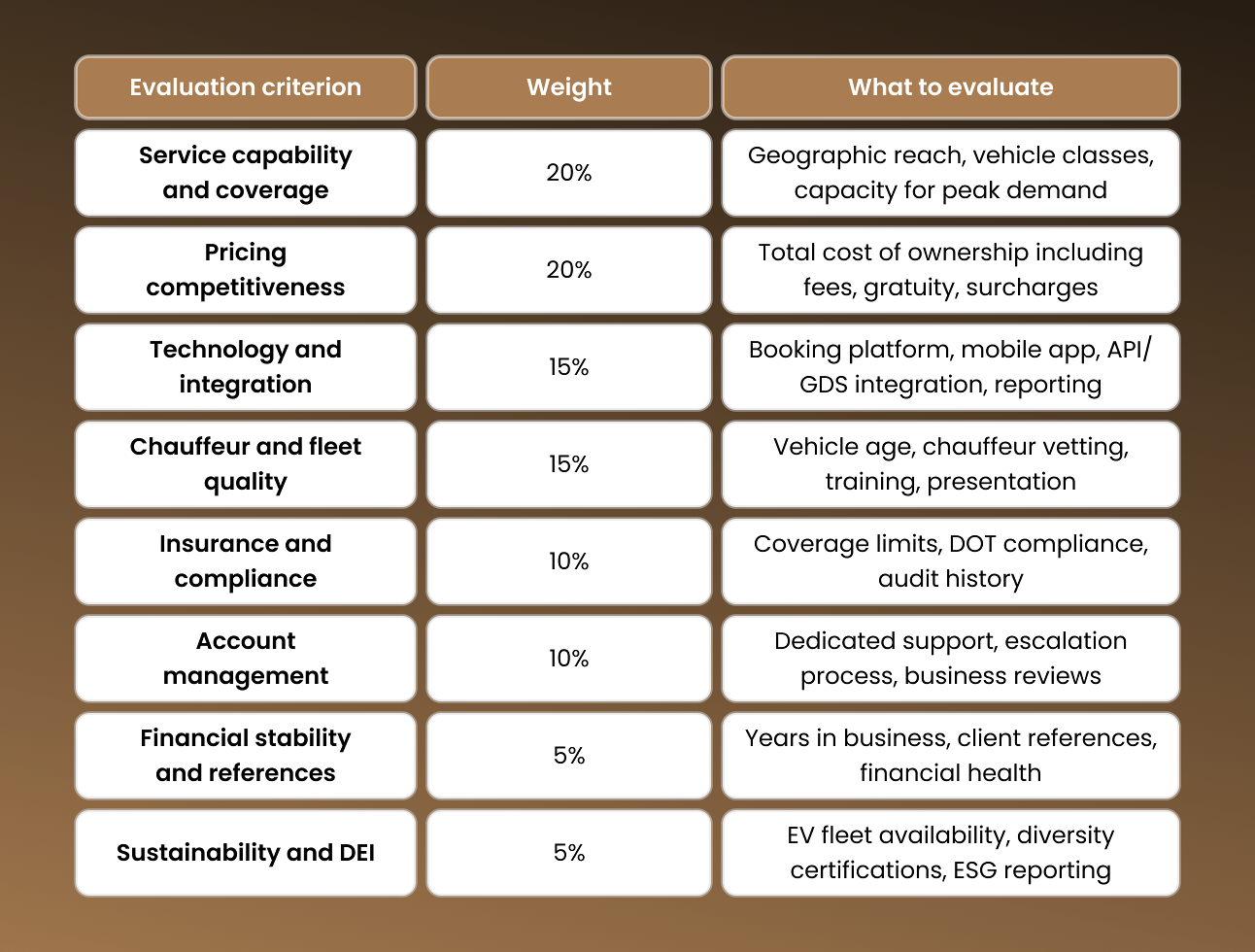
Most vendors score between 60 and 75 on a first pass. Top performers reach 80 or higher. Schedule oral presentations and reference calls for the top two or three finalists before final scoring.
Pricing models and corporate ground transportation contract terms
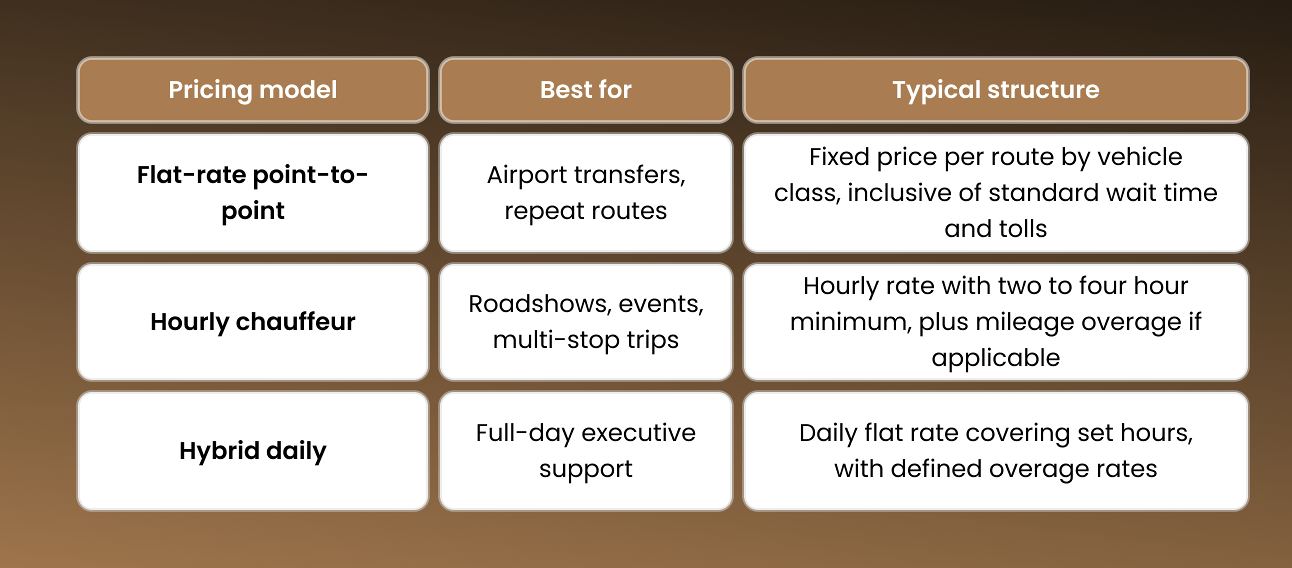
Corporate ground transportation contract terms typically follow one of three pricing models, often combined within a single agreement.
Standard contract terms to negotiate include:
-
Contract length: one, two, or three years, with renewal options.
-
Rate lock or annual escalator, capped at CPI or a fixed percentage such as 3 percent.
-
Volume discount tiers tied to annual spend or trip count.
-
Termination for convenience with 30 to 90 day notice.
-
Termination for cause tied to SLA breaches.
-
Liability caps and indemnification provisions.
-
Data ownership and confidentiality terms.
-
Force majeure provisions.
-
Payment terms: net 15, net 30, or net 45.
BostonPro operates on flat-rate pricing with no hidden fees, which simplifies budget forecasting and reduces invoice disputes. Corporate accounts include consolidated monthly billing, custom reporting, and a dedicated account contact.
Common RFP mistakes and how to avoid them
Five mistakes account for most failed corporate transportation RFPs:
-
Scope is too vague. RFPs that describe needs in general terms produce inconsistent proposals. Specify volumes, routes, vehicle classes, and service hours.
-
Pricing requests are not standardized. Without a pricing template, vendors quote in different formats and side-by-side comparison becomes impossible.
-
Too many vendors are invited. Inviting more than five or six vendors creates evaluation fatigue and dilutes the quality of the review.
-
SLAs are weak or absent. Without measurable SLAs, service quality cannot be enforced post-contract.
-
Evaluation criteria are not weighted in advance. Subjective scoring after proposals are read introduces bias toward incumbents and well-known brands.
A clear scope, a standardized pricing template, three to five qualified vendors, enforceable SLAs, and pre-agreed weighting fix all five issues.
How to write a transportation RFP for business: step by step
Companies that want to know how to write a transportation RFP for business can follow this six-step process:
-
Define scope and objectives. Lock down geographic coverage, service types, volume estimates, and the top three business outcomes the new program must deliver.
-
Build the evaluation team. Include procurement, travel, finance, and one executive sponsor. For programs with duty-of-care exposure, add risk or HR.
-
Draft the RFP document. Use a corporate car service RFP template covering the ten sections above. Include the pricing response template as an appendix.
-
Identify and invite vendors. Source three to five qualified vendors through existing relationships, TMC recommendations, and market research.
-
Run the RFP cycle. Allow two weeks for vendor questions, two to three weeks for responses, and one to two weeks for evaluation and finalist presentations.
-
Negotiate and award. Finalize pricing, SLAs, and contract terms with the selected vendor. Communicate the change to travelers and execute a transition plan.
A standard cycle takes four to six weeks from RFP release to vendor selection, with another two to four weeks for contracting and onboarding.
FAQ
What is a corporate transportation RFP?
A corporate transportation RFP is a formal procurement document a company sends to ground transportation vendors to solicit competitive proposals for executive travel, airport transfers, and event logistics. It standardizes vendor responses on scope, pricing, SLAs, technology, and compliance so procurement teams can compare offers consistently and select a primary vendor or panel.
How long does the corporate transportation RFP process take?
A typical corporate transportation RFP cycle takes four to six weeks from release to vendor selection. Add two weeks for internal preparation and two to four weeks for contracting and onboarding. The full timeline from kickoff to live service usually runs eight to twelve weeks for a mid-sized program and longer for global or multi-region awards.
What is the difference between an RFP, an RFI, and an RFQ?
An RFI (request for information) gathers general market and vendor capability data. An RFQ (request for quotation) requests pricing only on a defined scope of work. An RFP (request for proposal) combines both: it defines scope, requests pricing, and asks vendors to propose how they will deliver the service. Most corporate transportation procurements use an RFP.
How many vendors should a company invite to an transportation RFP?
Most procurement teams invite three to five qualified vendors. Fewer than three limits competitive pricing leverage. More than six creates evaluation fatigue and lowers response quality, since strong vendors may decline to invest in proposals they believe have low win probability.
What insurance coverage should a corporate transportation vendor have?
Most corporate RFPs require commercial auto liability of at least $1 million per occurrence, with $5 million coverage common for executive and roadshow work. Vendors should also carry general liability, workers compensation, and where applicable DOT operating authority. Require certificates of insurance naming the client as additional insured at contract signature.
How is corporate transportation pricing typically structured?
Corporate transportation pricing uses three primary models: flat-rate point-to-point pricing for airport transfers and repeat routes, hourly chauffeur pricing with two to four hour minimums for events and roadshows, and hybrid daily rates for full-day executive support. Volume discounts typically activate at defined annual spend or trip count thresholds.
What technology should a corporate transportation vendor offer?
Standard executive transportation service requirements include an online booking portal with corporate account access, a mobile app, real-time vehicle tracking, flight tracking for airport pickups, automated trip confirmations, consolidated monthly billing, and API or GDS integration with the corporate travel management platform. Custom reporting on trip volume, on-time performance, and cost by department is also standard for enterprise accounts.
Conclusion
A well-structured corporate transportation RFP protects budget, enforces service standards, and creates a clean basis for vendor selection. The ten core sections, weighted evaluation matrix, and standardized pricing template covered above form the foundation of a defensible procurement process.
To request a corporate proposal, schedule a discovery call, or set up an account with BostonPro Car Service for Greater Boston, New York, Philadelphia, and regional routes, visit bostonprocarservice.com or call +1 857 381-3564. Email proposal requests to info@bostonprocarservice.com.